
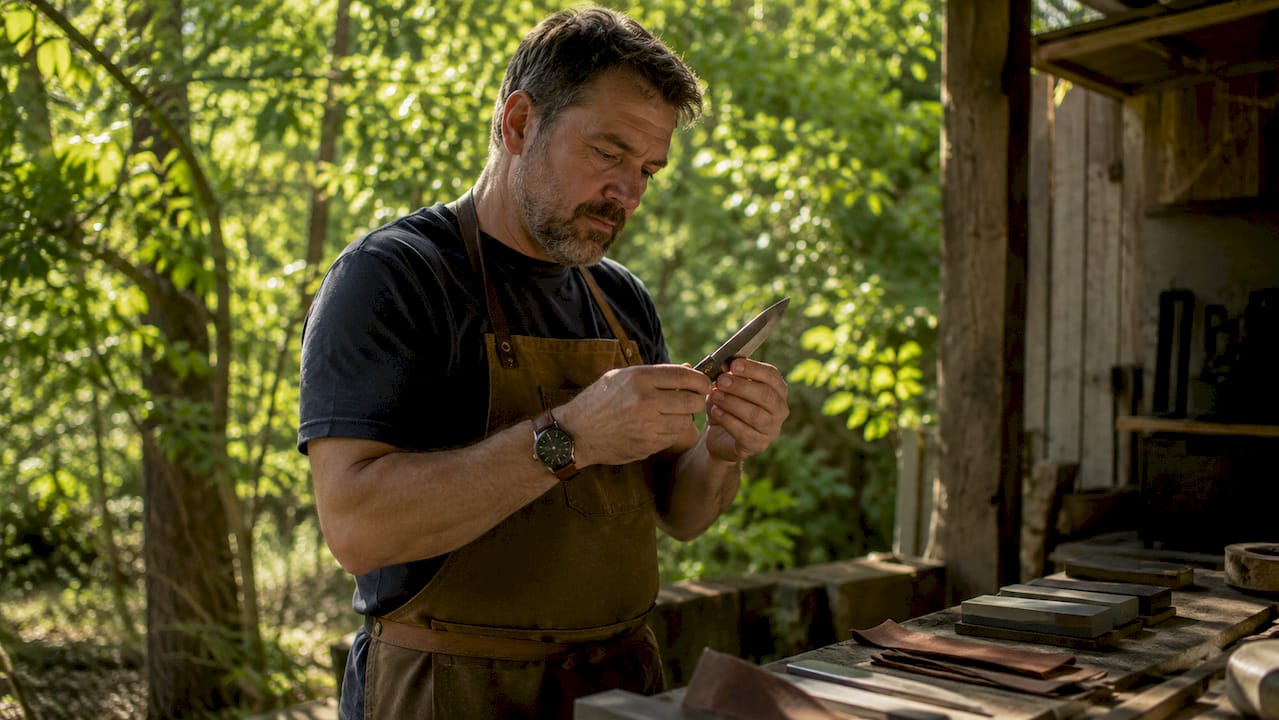
A CNC knife is defined as a blade shaped by computer-controlled machines, while a hand-ground knife is formed and refined manually by a skilled artisan. The CNC vs hand ground knife debate matters because the manufacturing method directly determines craftsmanship quality, grind geometry, and long-term performance. Collectors and enthusiasts often discover that these two production paths produce knives with genuinely different personalities. Understanding those differences helps you spend money wisely, whether you are buying for daily use, a collection, or a meaningful gift.
How does CNC technology work in knife manufacturing?
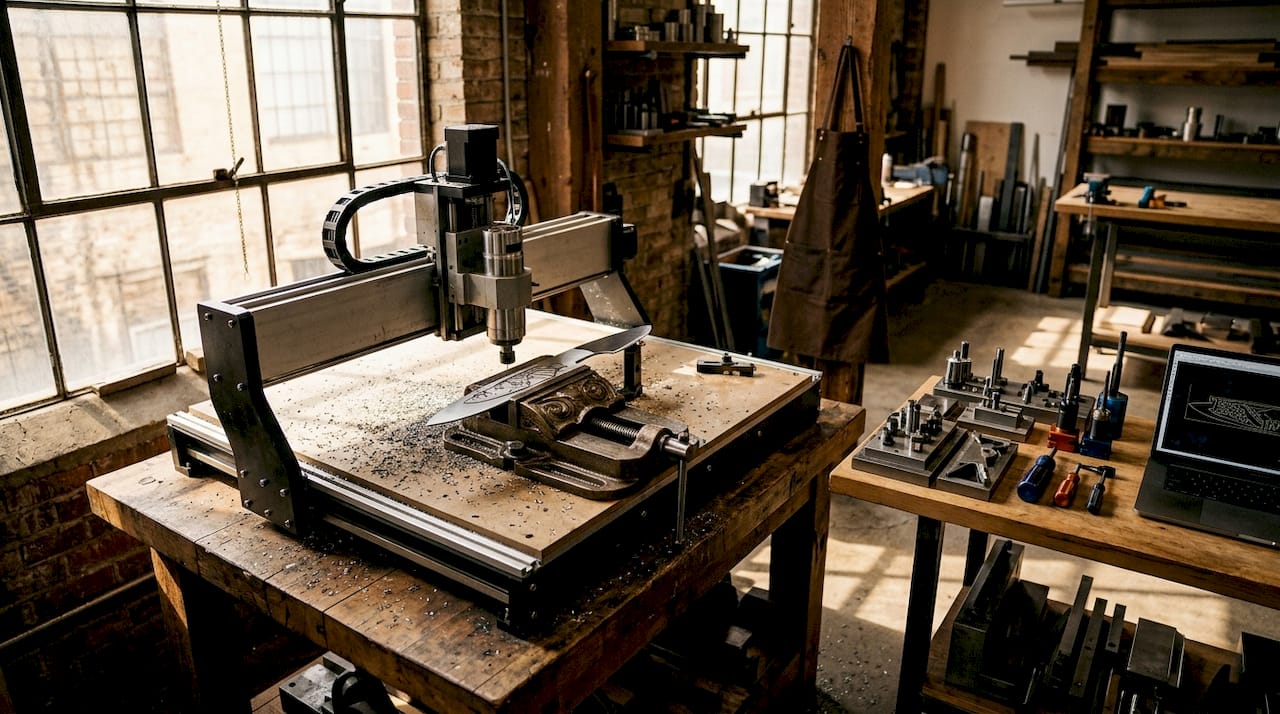
CNC knife manufacturing uses computer-controlled machines to cut, grind, and profile blade blanks with repeatable accuracy. The machine follows a programmed path, removing material from steel stock in precise increments. This process produces consistent blade profiles across large production runs without requiring a skilled operator at every step.
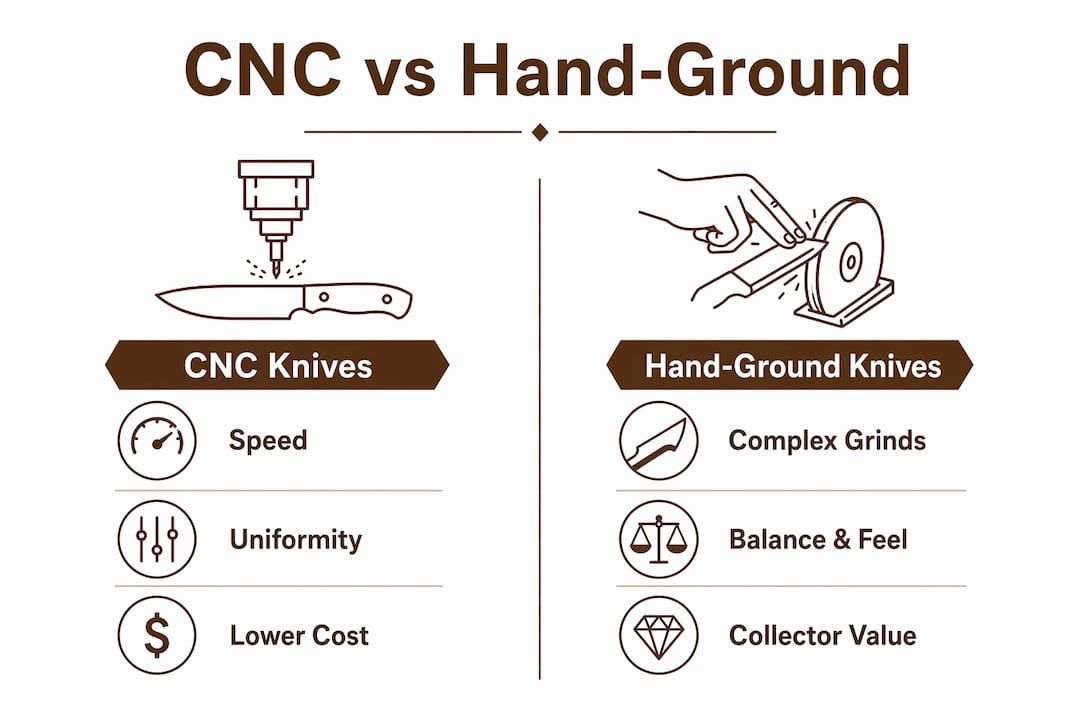
The main advantages of CNC production are speed and uniformity. Industrial CNC knife cutting systems operate 5–8 times faster than conventional laser cutters and support automatic nesting for efficient material use. That speed translates directly into lower per-unit costs for manufacturers and lower retail prices for buyers.
CNC systems are also accessible. Operators need no coding skill, and graphical software handles path planning. That low learning threshold makes CNC production practical for factories scaling output quickly.
The limitations show up at the edges, literally. CNC tooling wears down during grinding, and blade warping after heat treatment creates dimensional inconsistencies that machines struggle to correct in real time. Standard flat or hollow grinds work well within CNC constraints, but anything more complex pushes the process to its limits.
Key CNC knife advantages at a glance:
- Consistent blade geometry across every unit in a production run
- Lower retail price due to reduced labor costs
- Fast turnaround from design to finished blade
- Graphical software control with no specialized operator training required
- Reliable performance for standard grind profiles
Pro Tip: If you are buying a CNC knife for everyday kitchen or outdoor use, prioritize steel grade and heat treatment quality over the brand name. A well-treated CNC blade in a high-carbon steel like 1084 or D2 will outperform a poorly treated forged knife every time.
What makes hand-ground knives worth the premium?
A hand-ground knife is shaped by an artisan who uses grinding wheels, belt grinders, and hand tools to form the blade geometry by feel and eye. The process is slow, skill-dependent, and deeply personal. That combination produces results that CNC machines cannot reliably replicate.
The most significant advantage is grind complexity. Hand-ground knives feature nuanced geometries like convex grinds, S-grinds, and compound curves designed for superior food release and cutting efficiency. These shapes are rarely achievable through CNC manufacturing because tooling wear and blade warping make them economically impractical at scale.
The artisan’s adaptive feedback loop is the real differentiator. Hand grinding compensates for variability in steel temper, machining deformation, and edge thinness that automated processes cannot fully address. A skilled grinder reads the blade and adjusts pressure, angle, and speed in real time. That responsiveness preserves edge quality in ways no program can replicate.
Here is what the hand-grinding process typically involves:
- Profile cutting — The blade blank is cut to shape from bar stock or a forged billet.
- Primary grind — The artisan establishes the main bevel using a belt grinder or wheel, setting the blade’s geometry.
- Secondary bevel work — Fine adjustments create the specific grind profile, whether flat, convex, or compound.
- Heat treatment correction — The grinder compensates for any warping that occurred during hardening.
- Final hand sharpening — The edge is refined by hand to achieve the target geometry and sharpness.
Pro Tip: When evaluating a hand-ground knife, run your thumb lightly along the flat of the blade from spine to edge. A well-executed convex grind feels like a gentle arc with no flat spots. Inconsistency there signals rushed work.
How do CNC and hand-ground knives compare in performance?
Performance differences between CNC and hand-ground knives come down to four factors: edge geometry, edge retention, balance, and situational fit. Handcrafted knives typically provide sharper, more durable edges and personalized designs compared to factory-made knives that offer cost-effectiveness and uniformity. That said, production method alone does not determine performance.
Knife performance depends heavily on steel quality, heat treatment, and grind geometry rather than solely on whether a machine or a person shaped the blade. A poorly executed hand-ground knife will underperform a well-made CNC blade. The manufacturing method sets the ceiling, but quality controls determine where the knife actually lands.
Balance and feel differ noticeably between the two types. Hand-forged and hand-ground knives are heavier, more balanced, and more durable compared to stamped or CNC-produced knives, which tend to be lighter and less balanced. For collectors and serious cooks, that weight and balance translate into a more confident, controlled cutting experience.
| Feature | CNC knife | Hand-ground knife |
|---|---|---|
| Grind consistency | High across units | Varies by artisan skill |
| Grind complexity | Limited to standard profiles | Convex, S-grind, compound curves |
| Edge retention | Good with quality steel | Excellent with proper geometry |
| Balance and feel | Lighter, less nuanced | Heavier, more refined |
| Sharpening frequency | Moderate | Less frequent with complex grinds |
| Best use case | Daily tasks, entry-level buyers | Collectors, serious cooks, gifting |
Where each type excels:
- CNC knives perform well for high-volume kitchen tasks, outdoor utility work, and buyers entering the hobby
- Hand-ground knives shine in precision food prep, display collections, and situations where the knife’s story matters as much as its function
- For gifting, a hand-ground blade with a custom laser engraving adds a personal dimension that no factory knife can match
What do cost and long-term value look like for each type?
Price is the most immediate difference collectors notice. Factory-made CNC knives prioritize low cost and uniformity, resulting in lower retail prices compared to labor-intensive hand-ground knives valued as lifetime investments. The labor gap is the primary driver. An artisan may spend several hours on a single blade; a CNC machine produces dozens in the same time.
Hand-ground knives carry a price premium that reflects real costs: skilled labor, longer production time, and the artisan’s expertise in compensating for steel variability. That premium is not marketing. It is the cost of a blade shaped by someone who can feel the difference between a good edge and a great one.
Long-term value favors hand-ground knives for serious collectors. A well-made hand-ground blade, properly maintained, becomes a decades-long companion. CNC knives serve well as reliable daily tools, but they rarely become heirlooms. For buyers who want a knife they will pass down, the hand-ground option justifies the higher entry price.
| Consideration | CNC knife | Hand-ground knife |
|---|---|---|
| Entry price | Lower | Higher |
| Labor cost driver | Minimal | Significant |
| Heirloom potential | Low | High |
| Maintenance needs | Standard sharpening | Specialty sharpening for complex grinds |
| Best buyer profile | Budget-conscious, daily use | Collectors, gift buyers, serious enthusiasts |
Maintenance costs also differ. Standard CNC blade shapes work well with routine sharpening services. Hand-ground knives with convex or S-grinds require specialty sharpening to preserve the original geometry. Skipping that step degrades the very feature that makes the knife worth owning.
What do collectors and enthusiasts actually prefer?
The knife enthusiast community has a clear lean toward hand-ground blades, particularly for complex grind profiles. Complex grinds such as S or C grinds require post-heat treatment machining and hand sharpening due to tooling wear and blade warping, which limits CNC mass production feasibility. Enthusiasts recognize this and actively seek out artisan-made blades for their collections.
Mass manufacturers avoid the R&D and machine runtime costs required for precision complex shapes because most consumers do not prioritize them. That gap creates a niche market where hand-ground knives command loyalty and premium prices among those who know what they are looking at.
“The connection to the maker matters as much as the blade itself. When you hold a hand-ground knife, you are holding someone’s judgment, skill, and time. That is something a CNC machine cannot put into steel.”
— Sentiment widely shared across knife collecting forums and artisan communities
For gifting, this community insight is practical. A hand-ground knife with a known maker’s mark carries a story. CNC knives make excellent functional gifts, but for a collector, the artisan connection is part of the value.
Key Takeaways
Hand-ground knives deliver superior grind complexity and long-term value, while CNC knives offer consistent quality and lower cost for everyday use.
| Point | Details |
|---|---|
| Manufacturing defines the ceiling | CNC sets consistency; hand grinding sets the upper limit of grind complexity and edge quality. |
| Complex grinds stay artisan-made | S-grinds, convex grinds, and compound curves remain impractical for CNC due to tooling wear and warping. |
| Performance needs quality steel | Steel grade and heat treatment matter more than production method for real-world cutting performance. |
| Cost reflects labor, not just materials | Hand-ground knives cost more because skilled artisan time is built into every blade. |
| Maintenance must match the grind | Complex hand-ground profiles require specialty sharpening to preserve their geometry and performance. |
What I have learned from working with both types
The biggest misconception I see is that CNC automatically means lower quality. That is not accurate. A CNC knife made from well-treated high-carbon steel with a clean flat grind will outcut a sloppily hand-ground blade on most kitchen tasks. The production method is not a quality guarantee in either direction.
Where I consistently see hand-ground knives pull ahead is in the details that only matter to people who pay attention. The way a convex grind releases food. The way a well-balanced blade sits in your hand after an hour of prep work. Those things are hard to quantify but easy to feel. CNC knives rarely deliver them at the same level.
For collectors, my honest advice is this: buy the best CNC knife your budget allows for daily use, and save for the hand-ground piece you actually want. Do not compromise on the hand-ground blade to save money. The whole point of owning one is the craftsmanship, and a rushed artisan job is worse than a good factory knife.
The gifting question is simpler. If the recipient uses knives seriously, a hand-ground blade with a personal touch is the right call. If they are a casual cook who needs a reliable tool, a quality CNC knife is a thoughtful and practical gift. Know your audience, and the choice makes itself.
— William
Quality knives and sharpening services at Gettothepointllc
Whether you are building a collection or looking for a reliable everyday blade, Gettothepointllc carries a selection of quality knives built for performance and craftsmanship. We also offer sharpening services designed to match the blade you own, not just a generic edge.

For standard CNC blade profiles, our standard blade sharpening service restores a clean, consistent edge. For hand-ground knives with convex or specialty grinds, our specialty blade sharpening service preserves the original geometry that makes those blades worth owning. We also offer knife engraving for collectors who want a personal mark on a meaningful blade. Review our sharpening service policy for mail-in details and turnaround times.
FAQ
What is the main difference between a CNC and a hand-ground knife?
A CNC knife is shaped by computer-controlled machines for consistent, repeatable geometry. A hand-ground knife is formed manually by an artisan, allowing for complex grind profiles that machines cannot reliably produce.
Are hand-ground knives always better than CNC knives?
Not always. Knife performance depends on steel quality, heat treatment, and grind geometry rather than production method alone. A well-made CNC knife in quality steel outperforms a poorly executed hand-ground blade.
Why do complex grinds like S-grinds only appear on hand-ground knives?
Complex grinds require post-heat treatment adjustments and real-time feedback that CNC tooling cannot provide. Tooling wear and blade warping make these profiles economically impractical for mass CNC production.
How often do hand-ground knives need sharpening?
Hand-ground knives with convex or compound grinds hold their edges longer than standard flat-ground blades. When they do need sharpening, they require specialty techniques to preserve the original grind geometry.
Which type of knife makes a better gift for a collector?
A hand-ground knife is the stronger gift for a serious collector because the artisan craftsmanship, grind complexity, and maker connection add value beyond the blade’s function. CNC knives make excellent gifts for practical, everyday users.
Leave a Reply