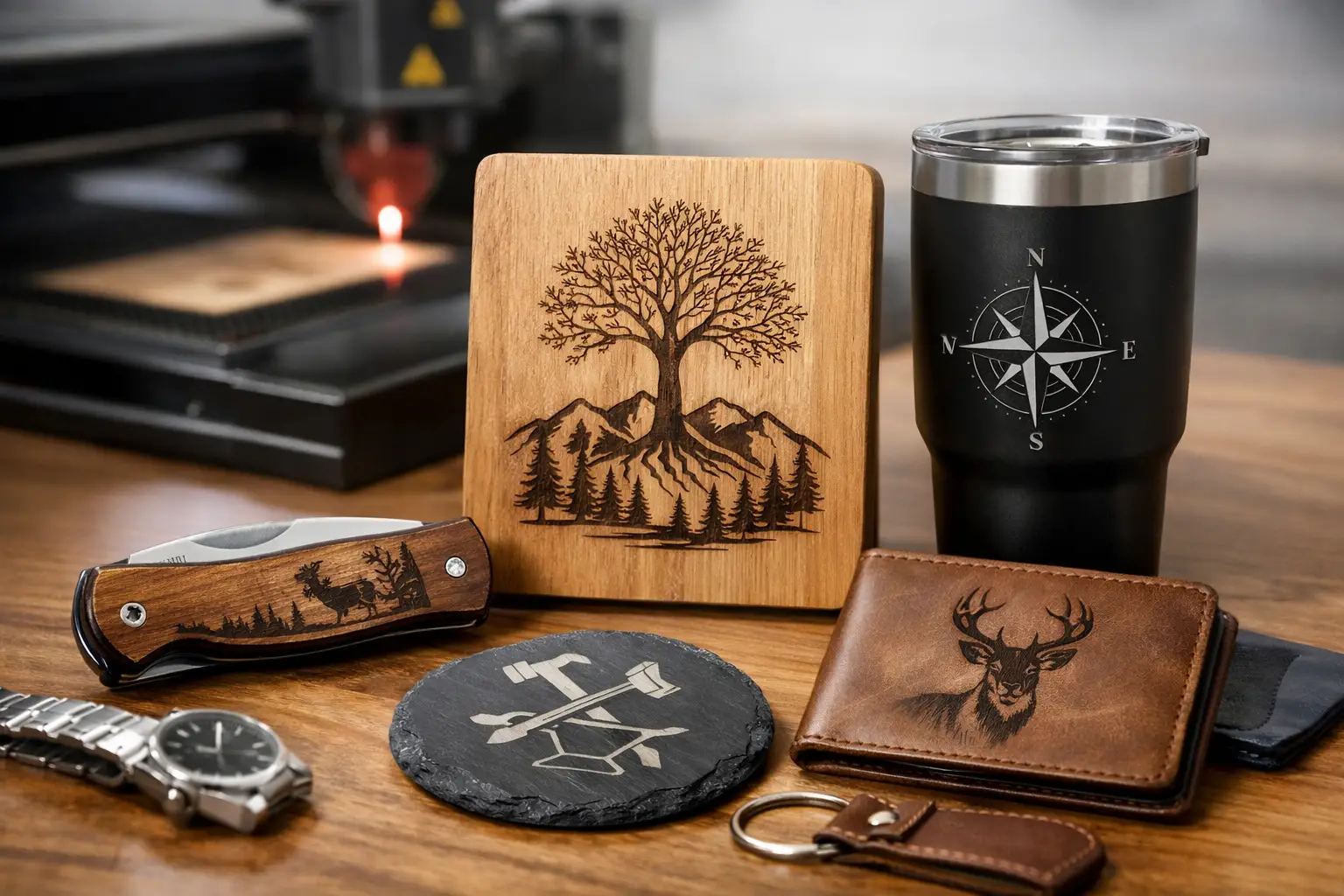
A good engraving should do more than fill empty space. The best laser engraving examples turn useful gear, kitchen tools, and everyday pieces into something unmistakably personal. A name on a knife keeps it from getting mixed up at camp. A family recipe on a cutting board keeps a memory close to the kitchen. A clean logo on slate gives a business gift real weight.
That is the standard: clear detail, the right material, and a design that still makes sense years from now. Whether you are choosing a gift, marking your own equipment, or ordering pieces for a team or event, the strongest ideas start with how the item will actually be used.
Laser Engraving Examples for Useful, Personal Gifts
Engraved pocket and hunting knives
A pocket knife is one of the most practical items to personalize. Initials, a last name, a meaningful date, a military insignia, or a simple outdoor design can turn a dependable tool into a keepsake without making it too precious to carry.
For hunters and outdoorsmen, consider a deer, turkey, fish, dog, mountain range, or camp coordinates. Keep the artwork bold. Fine lines can look sharp on the screen but may lose impact on a small knife handle. A strong silhouette, clean lettering, and enough open space usually produce the better result.
Engraved knives also make solid gifts for groomsmen, fathers, graduates, and retiring coworkers. The key is matching the message to the person. A full quote may fit a display piece, while a working pocket knife often calls for initials and a date. Simple lasts.
Kitchen knives with a personal mark
A kitchen knife can carry a name, a monogram, a short phrase, or a logo that identifies it as part of a home or professional set. Personalized kitchen knives are especially fitting for home cooks, barbecue fans, newlyweds, and people who take pride in feeding a crowd.
There is a practical side to this kind of engraving. In a shared kitchen, labeled knives are easier to return to the right owner. For a serious cook, a maker-style mark or name adds a professional touch. It is a small detail, but it says the tool was chosen on purpose.
Before engraving any knife, consider where the design belongs. Handles often provide more room and contrast than blades. Blade engraving can look clean and precise, but it needs to be placed carefully so it does not interfere with the knife’s function, finish, or future sharpening needs. A skilled shop will help identify the safest, best-looking placement.
Cutting boards that belong in the kitchen
A cutting board is one of the most versatile engraved gifts because it can be displayed and used. Family names, established dates, recipe cards, cabin names, ranch brands, and custom artwork all work well when the board has enough open surface.
Recipe engravings are a standout choice. A handwritten recipe from a grandmother, parent, or loved one can be reproduced as a lasting kitchen piece. The handwriting is what makes it matter. It keeps the uneven lines, the familiar pen strokes, and the character that typed text cannot replace.
For everyday boards, keep the engraving in a corner, along a handle, or on the back. That preserves a clean work surface. For a display board or charcuterie board, a larger center design can be the right call. The trade-off is simple: the more artwork you place in the main cutting area, the more likely it is to see wear from regular knife use.
Slate coasters with real character
Slate has a natural, rugged texture that gives laser engraving a different look from wood or metal. It works well for coasters, housewarming gifts, wedding favors, cabin decor, and business sets. A family name, monogram, lake outline, or local landmark looks right at home on slate.
Because the surface has variation, designs should be chosen for contrast rather than tiny detail. Bold text and recognizable graphics tend to stand out best. Four matching coasters can carry one design, or each coaster can feature a different image tied to the recipient’s interests: fishing, hunting, cooking, camping, or a favorite dog breed.
Wood items that carry a story
Wood engraving has warmth that manufactured gifts cannot fake. It is a natural fit for signs, keepsake boxes, ornaments, serving trays, plaques, and custom shop pieces. Grain patterns, wood species, and finish all affect the final appearance, which means every piece has its own character.
That variation is part of the appeal, but it is worth understanding before you order. Darker wood can create a subtle, rich engraving. Lighter wood may show more contrast. Heavy grain can add visual interest, though it can compete with very fine artwork. If the design includes detailed handwriting, small text, or a logo with thin lines, choosing the right wood and size matters.
Choosing Designs That Engrave Cleanly
The best design is not always the busiest one. Laser engraving rewards contrast, clear lines, and thoughtful scale. A meaningful idea can be reduced to a simple mark and still say more than a crowded layout.
Start with the item. A small knife handle has different limits than a large cutting board. A round coaster needs a layout that works within a circle. A supplied item may have curves, coatings, hardware, or textured areas that affect where engraving can go. Good customization begins with the actual piece, not just the image file.
Text needs the same attention. Script fonts can be personal and handsome, especially for names or recipes, but they must remain readable at the final size. Block lettering is often better for dates, coordinates, logos, and working tools. If a design cannot be read from arm’s length, it may be trying to do too much.
Photos can sometimes be engraved, but they are not always the strongest choice. A high-contrast image with a clear subject has the best chance of translating well. Busy backgrounds, poor lighting, and tiny facial details can become muddy. In many cases, a clean portrait outline, pet silhouette, or custom line drawing delivers a sharper result than a full photo.
Customer-Supplied Items: What to Check First
Bringing in your own item opens up more possibilities, from a favorite knife to a treasured wooden box. It also calls for a little planning. Material, finish, size, condition, and engraving area all matter.
Check whether the item has a coating or finish that may react differently under the laser. Look for uneven surfaces, deep curves, fragile areas, or decorative hardware. If it is a knife, consider whether it needs sharpening before or after personalization. A clean engraving and a properly sharpened edge make the piece feel finished, not merely decorated.
Provide the best artwork you have. Vector files are ideal for logos, but a clear, high-resolution image can work for many designs. Avoid screenshots when possible. They often introduce blur, strange backgrounds, and low detail that show up in the finished engraving.
It also helps to decide the priority before the work begins. Is the item meant to be used hard, displayed, gifted, or passed down? A working knife may need a compact mark in a protected location. A retirement plaque can support more text. There is no single right answer, only the right design for the job.
Ideas for Milestones, Teams, and Everyday Pride
Personalization earns its place when it connects an item to a moment or a person. Popular projects include wedding-party knives, anniversary cutting boards, memorial recipe boards, retirement gifts, employee recognition pieces, and branded items for small businesses. For Southwest Missouri hunters, cooks, tradesmen, and families, a practical item with a personal mark often beats another generic gift card.
For groups, consistency matters. Use the same main design across every item, then add individual names or roles. This keeps the set looking intentional while making each piece personal. For businesses, a simple logo and contact detail can work well on practical giveaway items, but avoid packing every available inch with information. A clean mark is more likely to stay on a customer’s counter, desk, or workbench.
Get to the Point LLC brings engraving and knife care together for people who expect their tools to work as well as they look. That combination is useful when a gift knife needs both a custom mark and a properly finished edge.
Choose an item with a purpose, give the design room to breathe, and let the material do some of the talking. The result will not just look custom. It will feel like it was made for the person holding it.
Leave a Reply